
Two sites with the same niche, similar content and approximately the same amount of links. But one is stable in the top, the other has been stuck on the second or third page for months and can't move. The difference between them is seven years of domain registration. The first appeared in 2016, the second in 2023. All other things being equal, but the search engine has long decided who to trust more.
Domain age is one of those SEO factors that is less talked about than links or content, but which quietly works in the background all the time. It is not a verdict or a guarantee, but it is a context that affects how search engines evaluate a resource, especially in competitive niches where other parameters are roughly equal.
What is domain age and how is it determined?
The age of a domain is the time between the date of first registration and today. It seems simple, but there is a nuance that most people don't take into account.
The date of registration and the date of first indexing are different things. A domain can be registered in 2010, but have been parked for years without content. Search engines take into account not just the fact that the domain exists, but when the first indexed content appeared on it. A domain with a long registration but a short active history receives less benefit than you might expect from looking at the WHOIS date alone.
In addition, continuity is important. If a domain has changed owners several times, there have been breaks between registrations, or the content has changed dramatically, search engines may discard some of the accumulated trust. A domain with a ten-year continuous active history is worth significantly more than a domain with the same registration date, but two or three owners and years of downtime in between.
The age is determined through WHOIS (the creation date in the record is its starting point). Some services additionally check Wayback Machine data to show when the content first appeared on the domain and how it has changed over time.
Impact on SEO
Google does not officially confirm domain age as a direct ranking factor. But practice shows otherwise, and the SEO community has long noticed a pattern where old domains with a clean history build authority more easily, are faster to get out of filters for new sites, and are more stable in positions during algorithmic updates.
The mechanism is indirect, because an old domain means more time to accumulate backlinks, more time to index content, and a higher probability that someone has already linked to it naturally. The search engine sees not just the registration date, but the entire accumulated trail.
Therefore, before purchasing a ready-made website or domain for a new project, checking the age is a mandatory part of evaluating the asset.
How we chose the best services
As always, it was evaluated according to three criteria:
Data accuracy. Does the date match the real WHOIS? Does the service only take into account the registration date or does it also show the date of the first indexing through archival data? The difference between these two numbers is sometimes measured in years and fundamentally changes the picture.
Additional data. A good domain age checker shows more than just the date and number of years. It’s useful to see the registration expiration date, registrar, domain status, and sometimes snapshots from the Wayback Machine. The more context, the less you need to switch between tools.
Ease of use. Is registration required? How many clicks to the result? Can you check multiple domains at once? This is important for those who are analyzing several options before purchasing or comparing competitors.
TOP 5 domain age check services in 2026
1. Domain Age Checker by HyperHost
HyperHost is a Ukrainian hosting company with a set of free SEO tools, and their domain age checker is one of the most convenient on the list. The principle is the same as in their other utilities, with a minimum of steps and a maximum of useful information as a result.
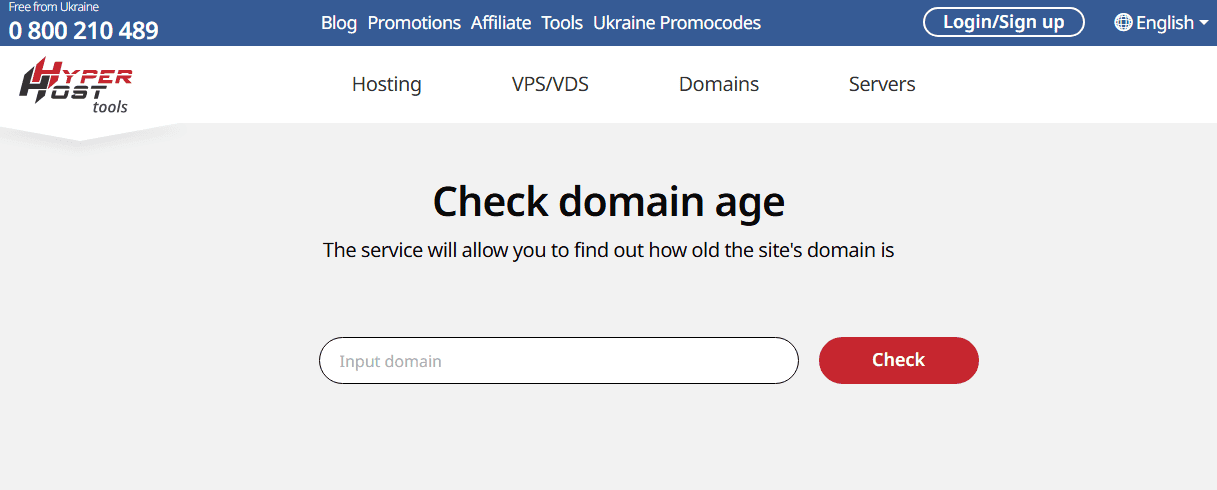
Enter the domain and get the registration date, exact age in years and months, registration expiration date and registrar. All in one place, no need to open WHOIS separately to find out the details. No registration required, and no limits on basic queries.
What sets the tool apart is its correct processing of domains in the .ua zone and Cyrillic domains. For Ukrainian SEO specialists and website owners who work mainly with the local market, this is a practical advantage that most foreign analogues do not provide.
The result is displayed in a structured way and is easy to read, as the age is immediately expressed in an understandable format, and you don't need to calculate the difference between dates yourself. It's good for a quick check before buying a domain, competitor analysis, or a basic SEO audit.
2. SmallSEOTools Domain Age Checker
SmallSEOTools is a large aggregator of free SEO tools, and their domain age checker is one of the most popular in this category by number of users. The reason is simple: it works without registration, gives results quickly, and shows more than just the date.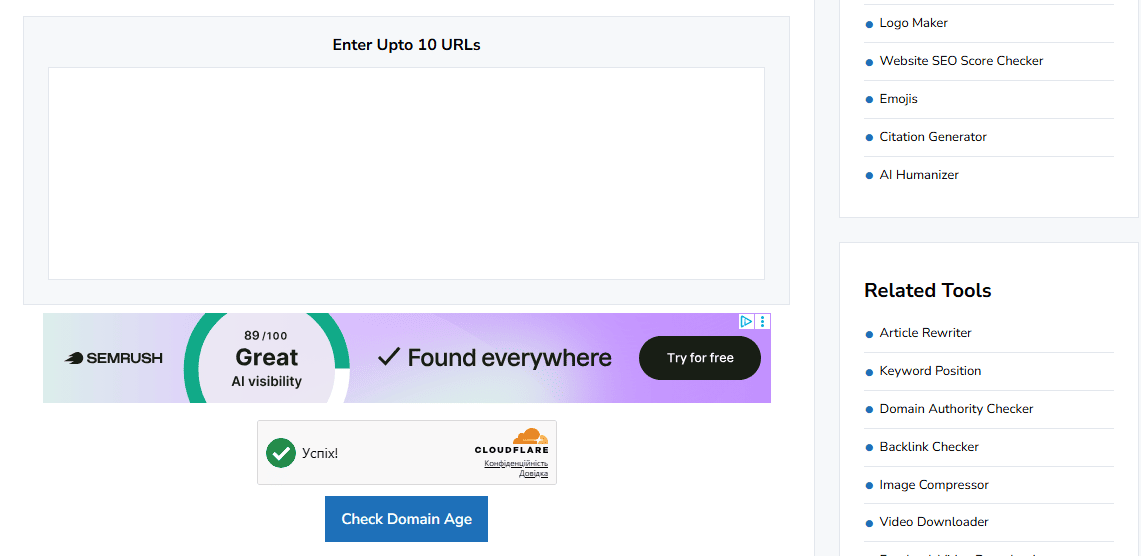
Along with the domain age, the service displays the registration date, expiration date, registrar, and basic WHOIS information. It is possible to check multiple domains at once, which is especially useful when comparing multiple options or analyzing competitors in a niche.
The interface is in English, but intuitive. Advertising is present, since this is a free tool on a large SEO portal, and this is felt in the number of banners around the result. It does not interfere with work, but the aesthetics are appropriate.
A good choice if you need to quickly check several domains at once and don't want to waste time registering with a separate service.
3. DupliChecker Domain Age Checker
DupliChecker is another SEO tools aggregator with a large audience, and their domain age checker stands out with one specific nuance: the service shows not only the registration date from WHOIS, but also tries to determine the date of the domain's first appearance in the index through archival data.
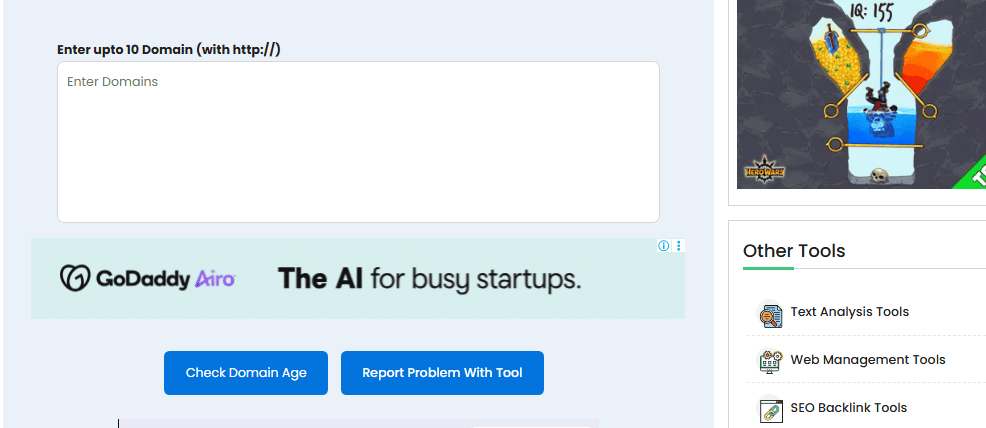
This is an important detail for SEO analysis. A domain may have been registered a long time ago, but if it was parked for years or used for content that then completely changed, the real SEO weight will be different from what the registration date shows. DupliChecker gives both numbers, and the difference between them is already information.
The basic check is free and without registration. The interface is simple, the result is clear. There is advertising, but within reasonable limits.
It is most useful when you need to assess not just how old the domain is according to documents, but what its actual active history is.
4. PrepostSEO Domain Age Checker
PrepostSEO is a platform with a set of SEO tools focused on mass batch processing. Their domain age checker supports checking up to ten domains per request in the free version — the largest batch limit among the free tools on this list.
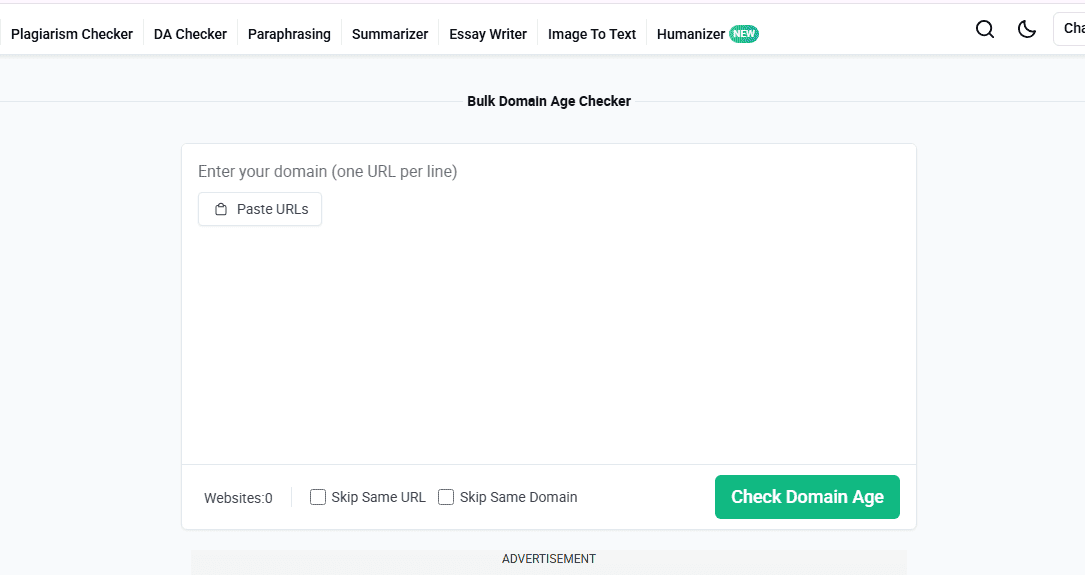
For competitive analysis or selecting domains to buy, this is a significant advantage. Instead of entering domains one by one and waiting for the result each time, you simply download the list and get a comparison table right away.
The result includes the registration date, age, registrar, and status. The interface is in English, a bit overloaded with additional offers of paid features, but the basic task is performed quite quickly.
Well suited for SEO specialists and analysts who need to regularly compare the age of multiple domains at once without manually entering each one separately.
5. WebConfs Domain Age Tool
WebConfs is one of the oldest web tools sites, dating back to when there were only a few of these services. Their domain age tool is minimalistic. You enter a domain and get the registration date and age.
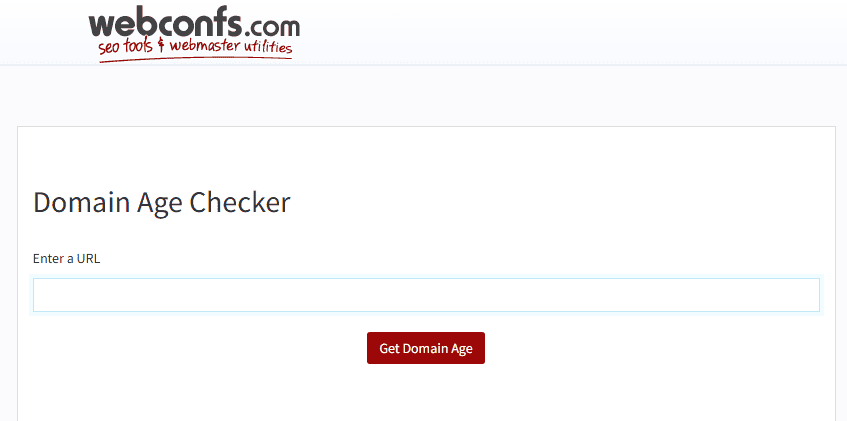
This is both an advantage and a limitation at the same time. The interface loads instantly, the result appears in a second, there are no ads around and no unnecessary elements. But there is no additional data such as the type of registrar, status, or expiration date.
For a quick one-time check when you need a single number and nothing else, WebConfs is perfect. It does the job better than any other tool on the list precisely because of its simplicity. But for a full domain analysis before buying a domain, it may not be enough, in which case it is better to take something with more data.
WebConfs is definitely a good choice when you need to simply and quickly check your age without unnecessary clicks and banners around the result.
Who to elect in 2026
For a quick check with a clear result, and especially if you work with Ukrainian domains, Domain Age Checker from HyperHost completes most tasks without registration and unnecessary steps.
For those who need to check several domains at once and compare them with each other, SmallSEOTools or PrepostSEO provide batch checking in a free mode, which significantly saves time when working with the list.
When it is important to understand not just the registration date but the actual active history of a domain, DupliChecker with its archived data gives a more complete picture and helps avoid a situation where an old domain turns out to be old only on paper.
When you need a single number and as quickly as possible, WebConfs will respond in a second without registration or advertising.
Domain age is not the only factor and not a verdict. A young domain with quality content and the right strategy can bypass an old competitor that has been standing still for years. But when all other parameters are equal, age tips the scales. Knowing this number before buying a domain, evaluating a competitor or planning an SEO strategy is an opportunity to make decisions based on complete information.