When people talk about digital trends, they usually mean something that is constantly changing. New platforms, new formats, new rules of the game that have to be relearned every few years. Against this background, short links seem almost boring – and that is their strength.
A short link doesn't try to be trendy. It doesn't depend on social media algorithms, isn't tied to a specific content format, and doesn't change its function with the advent of another platform. It's a basic tool that works the same in 2015 as it does in 2026.
That's why short links survive trends, not disappear with them. They don't compete with new tools, but quietly integrate into any ecosystem – from messengers to offline materials – and simply do their job.
Short links are not dependent on trends
In the digital world of 2026, almost everything is changing: content formats, platforms, algorithms, even user behavior. But short links remain almost unchanged. The reason is simple - they are not tied to fashion. A short URL does not depend on whether TikTok is popular now, or Threads, or another messenger that "everyone started using". It is a basic infrastructure tool that works on top of any channel.
That’s why businesses, media, and tech teams continue to use short links as a universal format. The same URL can be inserted into an email, messenger, QR code, presentation, or whitepaper and it won’t lose its meaning. This is especially important in 2026, as campaigns outlive individual platforms.
In practice, this also means control. When a link passes through a URL shortening service, it becomes possible to see what happens to it after publication. Surli in this context does not look like a "marketing tool", but rather a technical layer between the content and the user. It does not try to be trendy - it simply provides a stable entry point that will survive the change of channels and formats.
Social networks, messengers and mobile screens
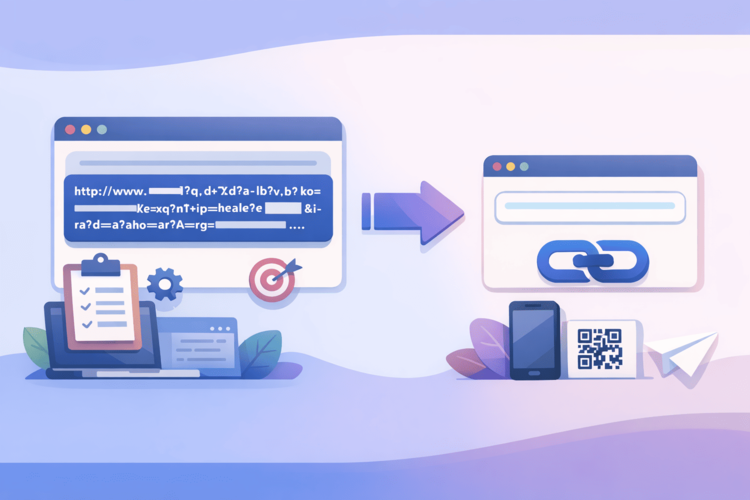
In 2026, most of the conversions will occur from mobile devices. Small screen, fast scrolling, minimal attention. In such an environment, long URLs with parameters look like noise. They break the layout, get cut off, sometimes they don’t even open completely. The user doesn’t read them – he either clicks or doesn’t.
A short link works differently. It is compact, visually neat and does not overload the interface. In messengers this is critical: a long link can look suspicious or simply annoying. In social networks it is even worse, because there the decision is made in a second.
This is where short URLs remain relevant not as a "convenience" but as a necessity. Surli is used in this scenario as a way to make the link readable without losing functionality. You don't think about what the UTM string looks like or the technical parameters. You just get a link that looks normal on a mobile screen and doesn't scare the user away before they even click.
Short URL = convenience and trust
The year 2026 is a time when users have learned not to trust everything. Phishing campaigns, fake pages, fake stores have become so common that any strange link automatically raises suspicion. A long URL with a set of random characters is one such trigger.
A short link takes some of this tension away. It looks clear, doesn't hide unnecessary details, and doesn't create the impression of a technical trap. Especially if the service allows you to quickly check where exactly the link leads. Here, Surli again works natively – not as a "security guarantee," but as a transparency tool.
When a user sees a short URL and can understand what’s behind it in a few seconds, their trust level increases. It’s a small thing, but on a campaign scale, it’s these little things that affect CTR and post-click behavior. In 2026, convenience and trust are no longer abstract concepts – they directly affect the result.
How link validation affects CTR
CTR rarely drops because of the content itself. More often than not, the user simply doesn’t get to it. The decision to “click or not” is made in seconds, and the link is one of the first points where this process stops. If the URL looks suspicious or unclear, the user chooses the safe option – not to click.
The ability to check a link before clicking lowers this barrier. When the user sees exactly where the link is going, the sense of risk disappears. This does not create additional motivation, but it removes fear. And in many scenarios, it is fear, not lack of interest, that stops the click.
On a campaign scale, this has a measurable effect. Links that look clear and transparent get more clicks, even with the same content. Surli works here as a tool to dispel doubts. The user doesn't "take it at face value," he just checks and clicks. In 2026, CTR increasingly depends not on the volume of the message, but on how safe the first step looks.
Post-publish link control
One reason why short links don’t disappear is post-publishing control. Content lives longer than a campaign. Links can remain in posts, emails, presentations, PDFs, and even printed materials. And there almost always comes a point when the goal needs to be changed.
Short link as a managed object
A regular URL is a static thing. It either leads to where it needs to go, or it's no longer relevant. When a page changes, a campaign ends, or a new landing page appears, the old link becomes a problem. It can't be "rethought," only replaced—and that's not always possible.
A short link works differently. It exists as a separate layer between the user and the content. This makes the link manageable. You can change the target, analyze the transitions, temporarily stop traffic or redirect it to another location without re-issuing the link itself.
In 2026, this is no longer a convenience, but an infrastructural necessity. Campaigns are adjusted on the fly, content is updated, products change. Surli in such a scenario is perceived not as a reducer, but as a control point. The link ceases to be disposable and begins to live with the project, not against it.
Who is link control critical to?
Link control can be critically important for many members of the digital community:
In marketing, it's all about efficiency. A campaign can change daily, and the ability to quickly redirect traffic without replacing links saves time and budget.
For media and content projects, it's a question of material longevity. Articles, posts, and newsletters continue to live for years, and a managed link allows you to not lose traffic even if the original page is no longer relevant.
For technical teams and support, link control is a matter of security and stability. The ability to quickly check or disable links with suspicious activity is often more important than detailed analytics.
This is where tools like Surli fit in most organically. They don't impose complexity, but give you enough control to make decisions without panicking and unnecessary movements.
Why short links won't disappear anytime soon
Short links don't try to be "smarter" than the user or replace analytics. They do a simple thing - remove unnecessary complexity between content and navigation. As long as mobile screens, limited interface space, and the need to quickly manage traffic exist, short URLs will remain relevant.
In 2026, they are no longer perceived as a temporary solution or a crutch. They are part of the basic digital toolkit. Surli in this context does not look like a service “about reductions”, but as a logical element of an ecosystem where transparency, control and predictability are important.
That's why short links are here to stay. They are platform-agnostic, format-agnostic, and trend-agnostic. And as long as businesses, media outlets, and users need simple, manageable entry points, this tool will remain relevant.