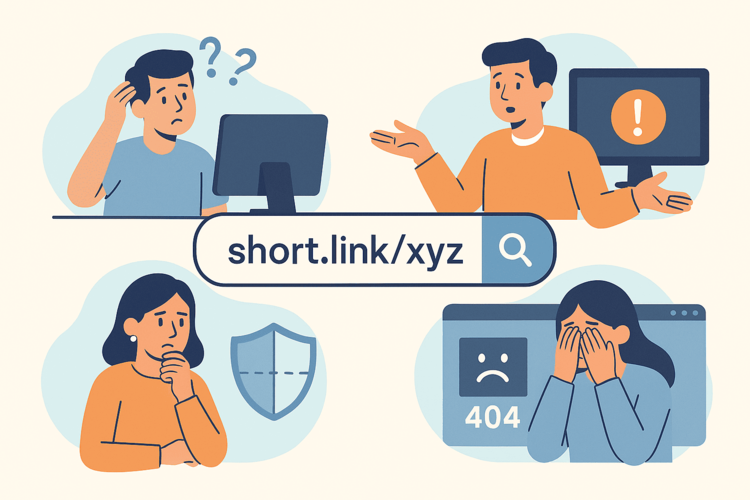
Short links look so simple that the brain automatically sends them to the "trifle" category. They created a link, inserted it into a post or email - and moved on as if nothing important had happened. They usually mention it in two cases: when a client writes "it doesn't open for you" or when analytics suddenly shows strange failures.
In 2026, this is no longer a minor technical glitch or a "oh, we'll fix it later" thing. A short URL can be an entry point for marketing, sales, and even support. And if something goes wrong with that point, the consequences will ripple through the entire system.
Most problems with short links arise not because of the format itself or because of "bad internet". They arise because of the attitude: as a disposable tool, and not as part of the infrastructure. Below are typical mistakes that are repeated with surprising regularity even in experienced teams.
Using random or unreliable services
The most popular mistake with short links starts as innocently as possible. You need to quickly shorten a URL, there is no time, the first service that opens in the search is the right one. And even better, if it is without registration, without an account and without unnecessary questions. Sounds convenient. It works exactly until the link becomes important.
At first glance, it really doesn't seem like there's any difference. All services do the same thing: take a long URL and return a short one. The problem is that the consequences of this choice don't appear immediately. They accumulate over time, as links start to live beyond a single campaign or post.
Random or unreliable services usually don't provide the basic things, without which a short link turns into a time bomb:
no guarantees that the link will work in a year;
unclear storage and support policies;
the ability to change the target or check what is happening with the traffic;
access to click history and statistics.
As a result, businesses build communications on infrastructure they don't own or control. Links appear in newsletters, social media, presentations, documents, QR codes. They become part of processes, but in fact remain "foreign."
When such a service changes its rules, introduces restrictions, or simply closes, not only the tool disappears, but also all the entry points that the business relied on. And the most unpleasant thing about this situation is that nothing was formally "broken" - it was just that one day the links stopped leading where they should.
Loss of access to an account with links
Another very common but underestimated mistake is when short links are tied to a specific person. The manager created the link. The marketer launched the campaign. The contractor "hastily" shortened the URL. At the moment it seems normal: the link works, clicks are coming, everyone is happy.
The problems start later. A person changes the project, leaves the company, or simply stops responding. And with them, access to the account where all the short URLs are stored disappears. Formally, nothing is broken. In fact, the business loses control over its own entry points.
This is not a technical error, but an organizational one. And that is why it is so painful. The links continue to live their own lives:
in old email newsletters;
in posts on social networks;
in presentations for partners;
in PDF documents;
in QR codes on packaging or stands.
But no one can manage them anymore. You can't change the page's purpose. You can't stop traffic. You can't check whether the link still works at all. If an error is discovered or the page is no longer relevant, there are few options - either put up with it or rework the content, which is often simply impossible.
In large teams, this quickly turns into a chaos of dozens of "dead" links. In small teams, it becomes an unpleasant surprise at the worst possible moment, such as during a campaign or release. And the longer the business ignores this problem, the more expensive it becomes to fix it.
Short links seem like a small thing until they become a critical part of processes. And that's when it becomes clear that they too must have an owner, access, and clear management rules.
Lack of inspection and monitoring
It is quite common to create a link, check that it opens, and move on. The logic is simple and human – "if it worked, it works". The problem is that the Internet does not have memory and stability, like an office printer. What was correct yesterday can break today without warning.
The landing page to which a short link leads is a living system. It can change during redesigns, migrations, CMS updates, or content edits. It can temporarily give errors, be closed due to access settings, or be blocked at the browser, network, or corporate filter level. And all this happens regardless of whether you remember the link or not.
Without regular checking, short links begin to "rot" quietly and imperceptibly. They still exist in posts, emails, and documents, but they lead to the wrong place or nowhere. The worst thing is that businesses rarely find out about the problem right away. Analytics show a drop in conversions. Advertising seems to be working, but there is no result. And the real reason is hidden in one of the dozens of links that no one has checked for a long time.
As a result, instead of simple prevention, an investigation begins. Creatives are checked, budgets are changed, algorithms are suspected, contractors are argued with. And only in the end does someone manually open the link and see a 404 or an old page.
Regularly checking short links is not about total control, but about hygiene. Just like updating passwords or backing up. It takes minutes, but saves hours of troubleshooting and days of lost productivity.
Ignoring click statistics
Another common mistake is to perceive a short link as a regular "pipe" through which traffic simply passes. The link exists, clicks are supposed to occur, so everything is fine. It is at this stage that businesses often lose one of the most valuable parts of the picture - data about the click itself.
When click statistics are ignored, a short link ceases to be a tool and becomes an expendable item again. It works or it doesn’t work, but why exactly remains hidden. In such a situation, businesses don’t see the basic things:
whether they click on the link at all;
which channels actually drive conversions;
is there a difference between platforms and formats;
Does traffic disappear before the site loads?
whether the link works stably over time.
The most unpleasant thing is that Google Analytics does not help here. If the user clicked, but the page did not open, the analytics will not see this. For GA, such a click simply does not exist. In the reports, everything looks clean, but the problem remains.
As a result, decisions are made "by eye". Channels are evaluated based on feelings. Creatives are changed at random. Budgets are redistributed without understanding where exactly the effect disappears. Analytics is formally available, but it is incomplete because it starts too late - after the transition to the site.
Click statistics on short links close this blind spot. They show what is happening at the entrance, even before the page loads. And it is this data that often explains what in other systems looks like "strange drawdown" or "unstable traffic behavior."
How to avoid common mistakes
Most of the problems with short links aren't really technical. They're about attitude. When a URL is perceived as a one-time thing – "shorten, paste, forget" – it sooner or later starts to break processes. It's worth changing the approach, and most of the risks disappear without complex solutions.
A short link works stably only when it is considered as part of the infrastructure, and not as a consumable. Just like a domain, analytics or access to advertising cabinets. It lives longer than one campaign, survives content changes and often remains active when no one thinks about it anymore.
To avoid common mistakes, it is enough to follow a few basic principles:
use managed services with transparent rules and clear responsibilities;
store accesses centrally and transfer them within the team;
periodically check active links, rather than waiting for a signal from customers;
Analyze clicks as a single event, rather than relying solely on sessions.
Document where and what each link is used for.
These actions do not require large resources, but they dramatically reduce the number of surprises. When links are checked, controlled, and their role in the processes is understood, they cease to be the weak link.
In this model, short URLs work for the business, not against it. They become a controlled entry point that can be modified, analyzed, and maintained. Not as a technical detail, but as an element of the system that calmly survives changes in campaigns, people, and channels.